
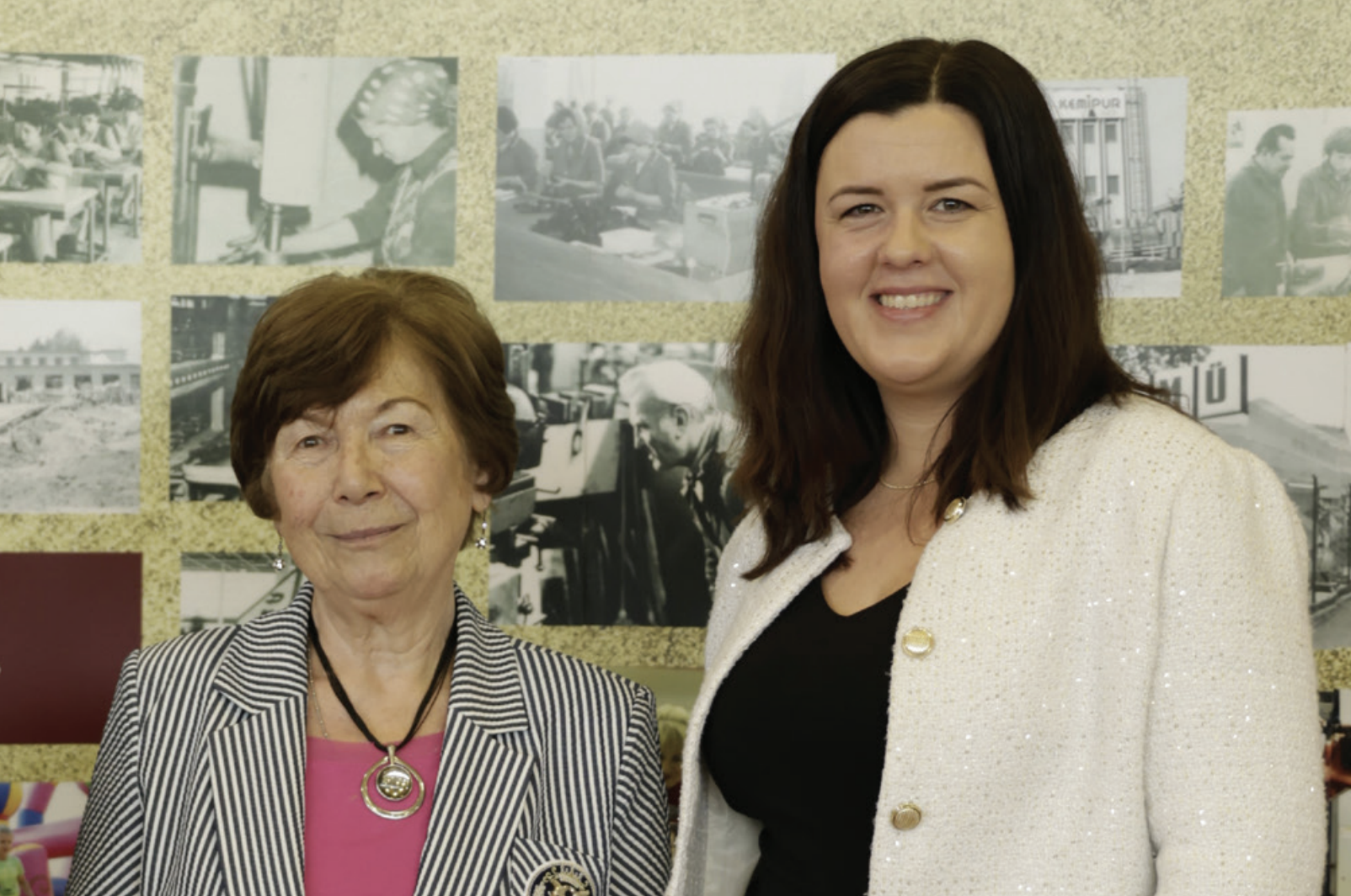
Lilla Hajdár Udvarosné, Deputy Chief Executive Officer of PEMÜ Plc., was invited to appear on the Kossuth Radio program Az este (“The Evening”). The program was hosted by economist and university professor Magdolna Csath, with whom she discussed the position, challenges, and opportunities of women in leadership.
The transcript of the interview was published in Polimerek, the professional journal of the plastics industry. It is reproduced below without any changes.
Successful Women in Corporate Leadership
Magdolna Csath’s Interview with Lilla Hajdár Udvarosné on the Situation and Challenges of Women Leaders
Although women now outnumber men among university graduates in Hungary, corporate leadership continues to be overwhelmingly dominated by men. Statistics clearly show that for many years more women than men have earned university degrees, yet this trend is hardly reflected in senior management positions.
At the same time, women’s role in the economy continues to strengthen year by year. According to the latest data, more than one thousand Hungarian companies with exclusively female management teams have achieved annual revenues of more than 1 billion HUF. The role of women leaders in Hungarian business was the topic explored by economist and university professor Dr. Magdolna Csath in her conversation with Lilla Hajdár Udvarosné, Deputy CEO of PEMÜ, on the Kossuth Radio program Az este.
Holding degrees in both economics and law, Lilla Hajdár Udvarosné has served for the past five years as Deputy CEO of one of Hungary’s largest plastics processing companies, while also raising two young sons. Dr. Csath’s choice of interview partner was therefore no coincidence, as successfully balancing education, career development, and family life remains a significant challenge for young women.
Dr. Csath opened the discussion by presenting statistical data on the position, challenges, and difficulties faced by women executives. She referred to a summary published by Fortune magazine, which analyzed the 500 largest companies in the United States. According to the report, only 6.6% of these companies are led by women. Yet the same study concluded that companies with women in leadership positions tend to perform better because female leaders are generally more successful at fostering workplace harmony and integrating diverse perspectives into decision-making. Women often demonstrate strengths such as social intelligence, problem-solving ability, and initiative—qualities that are particularly valuable in leadership. Despite these advantages, women remain significantly underrepresented in executive positions in the United States. Dr. Csath also pointed out that, compared with the European Union, the proportion of female executives is still higher in the United States, indicating that the situation in Europe is even less favorable.
Representing both the plastics industry and, as a female executive, the traditionally male-dominated technical sector, Lilla Hajdár Udvarosné confirmed that the situation in Hungary is not much better.
“According to the statistics, women account for approximately 20 percent of managers in Hungary,” she said. “This figure comes from a recent survey conducted by the Hungarian Chamber of Commerce. However, when it comes to top executive positions, such as Chief Executive Officer, the proportion drops to just 6 percent.”
She added that these figures vary considerably across different sectors. In industries such as banking and the public sector, the representation of women in leadership is significantly higher, or at least more balanced. In industry—particularly in the chemical and plastics sectors, with which she is most familiar—the ratio is even lower.
“These industries are still regarded as traditionally male professions. There are very few women in leadership positions, and I notice this most clearly when I attend professional conferences. Usually, one or two tables are occupied by women—that’s how few of us there are.”
Dr. Csath continued:
“Research shows that in today’s increasingly uncertain world, where human factors play a growing role, the kind of leadership approach often associated with women is needed more than ever. In your own position, do you feel that you face different challenges than your male counterparts? Are you accepted differently—whether by fellow executives or by your employees—because you are a woman? Based on your own experience, what are the specific advantages and disadvantages of being a female leader?”
According to Lilla Hajdár Udvarosné, all leaders, regardless of gender, encounter broadly similar challenges. However, from the perspective of organizational effectiveness, she believes that mixed-gender leadership teams offer clear advantages.
“I believe the most effective management teams are those in which men and women work together, combining different perspectives and discussing issues jointly from a leadership standpoint.”
She added:
“As a leader, I consider myself collaborative. I value my colleagues’ opinions and enjoy working through problems together with them. One could argue—although this would admittedly be a stereotype—that men tend to adopt a more authoritarian leadership style. However, I would avoid making such a generalization, as leadership style depends far more on personality than on gender.”
“I Wanted to Know Everything—Today I Know That’s Impossible”
Responding to the host’s question, Lilla Hajdár Udvarosné explained that, in her experience, acceptance is not determined by age either.
“I won’t deny that at first I was somewhat concerned about managing older male employees. However, I focused on fostering cooperation and encouraging us to think together. Fortunately, my experience has been extremely positive, and I was able to build a relationship with them based on mutual respect and acceptance.”
Dr. Magdolna Csath was also interested in whether Lilla’s extensive educational background—degrees in both law and economics, combined with many years of technical experience—helps a female executive establish rapport with her colleagues and subordinates. Or are differences more closely related to educational background than to gender?
According to Lilla Hajdár Udvarosné, each profession emphasizes different aspects of leadership, and this is where the most significant differences can be observed. In her view, people with technical backgrounds naturally focus on details, while it is equally important to maintain a strategic perspective and keep sight of the overall direction. Economists, on the other hand, tend to excel precisely in maintaining that broader perspective, helping organizations avoid becoming lost in the details.
“This was something I also had to learn,” she explained. “I used to feel that I wanted to know everything and understand every single detail, but I eventually realized that this is simply impossible.”
Five years of executive experience can provide a solid foundation for evaluating what changes are necessary—whether in one’s lifestyle or personal development—to become an effective leader. Dr. Csath therefore asked Lilla what she herself had needed to change in order to become more successful and gain greater acceptance. Had she altered her management methods? Her leadership style? And, more practically, how does a female executive enter a manufacturing plant? In formal business attire, or perhaps dressed more casually, even in jeans?
“As far as clothing is concerned, I’ve done both,” Lilla replied. “But generally, when I visit the manufacturing plant, I wear the same clothes that I wear in the office. I don’t feel that the way I dress has any influence whatsoever on my ability to connect with my colleagues. I believe we can safely exclude clothing from the factors that shape workplace relationships.”
She went on to describe the lessons she has learned over the years.
“What I truly had to learn was how to manage my time effectively. I had to accept that I cannot solve every problem on my own. Over the years, I realized that it’s impossible to fit everything into a single day. There are things I simply have to let go of, delegate to others, ask for help with—and, equally importantly, learn to accept that help. That has been one of my greatest learning experiences.”
“The other lesson, which I am still learning today, is how to leave work-related problems behind during my personal time. I have had to learn to give myself permission to rest and to recognize that proper rest is one of the foundations of long-term effectiveness.”
Compartmentalizing—An Effective Method
The importance of rest naturally raises another question: how can someone achieve it while raising a family—especially with two young children?
Dr. Magdolna Csath asked the question that concerns many working parents: how can a senior executive preserve harmony in family life when the company’s challenges are almost constantly occupying their thoughts?
Lilla explained that she consciously strives to maintain this balance. She has even given her own name to the technique she uses: compartmentalizing.
“I imagine a lock gate inside my mind. Behind that gate I collect all the work-related problems that arise during the day. When I’m resting or spending time with my family, I close the gate and try not to think about those issues.”
At the same time, she noted that her children have grown up knowing that both of their parents hold senior leadership positions.
“We have established a family routine that my husband and my older son actively support. He is now nine years old, so he understands when I ask him to play with his three-year-old brother for a little while because I need to deal with an urgent task. But afterwards, we spend time together and do whatever they would most enjoy.”
Role Models Are Our Greatest Teachers
Role models and mentors can play an invaluable role in a leader’s development. They are people we trust, whose guidance we can confidently follow when faced with important decisions. They provide reassurance, and we can ask ourselves what they would do in our situation. Such mentors may be family members, people from our wider circle, teachers, or even well-known leaders encountered through professional literature.
Dr. Magdolna Csath also addressed the importance of role models. Lilla immediately named her mother, Elvira Molnár Hajdárné, President and CEO of PEMÜ, as both her greatest role model and mentor.
“We still work together today, so I have the opportunity to ask her questions and discuss issues with her every day. I believe this is a tremendous source of confidence for any woman in a leadership role. Seeing someone who has already accomplished what lies ahead of you demonstrates that the task is achievable and not something to fear.”
A strong parental example can provide invaluable guidance, but it may also make it more difficult to assert one’s own views. Respect for authority, as well as differences in knowledge and perspectives between generations, can sometimes lead to hesitation. Successfully navigating such relationships requires a high degree of mutual openness and acceptance—qualities that ultimately depend on personality.
Lilla assured her interviewer that open communication has always worked exceptionally well with her mother, just as it does with her husband. Although they work in different fields, they regularly discuss professional challenges together.
“My husband and I enjoy thinking through problems together. I help lead a large company, while he manages a small business, but despite the difference in scale, the issues we face are surprisingly similar. Human resources is probably the area that presents the greatest challenges for both of us.”
She added that one recurring topic is the effective flow of information throughout an organization.
“In a large company, communication is naturally more complex, but the underlying challenge is much the same. We often discuss how to ensure that information reaches everyone in the organization in a way that allows every employee to understand not only the message itself but also the company’s strategic direction.”
The Best Professionals Are the Ones a Company Trains Itself
In the next part of the discussion, Dr. Csath referred to a survey conducted by the European Investment Bank, based on responses from 12,000 companies. The findings showed that the greatest challenge facing both European and American businesses is recruiting and retaining qualified employees.
She then asked how this issue affects PEMÜ, which employs nearly 300 people.
“This is certainly a topic that frequently comes up whenever business leaders in Hungary talk to one another,” Lilla replied. “I wouldn’t claim that we have never experienced difficulties ourselves, but we have one significant advantage.”
She explained that more than a decade ago the company established its own training workshop dedicated to educating young people.
“Especially in the early years—and to some extent even today—it required a tremendous investment of time and energy. However, our experience has shown that, over the long term, the effort pays off.”
Through this initiative, the company is able to recruit employees who are already familiar with the organization before they begin working there.
“They know exactly what kind of workplace they are joining, and we already know them as well. We cooperate with schools through a dual education model. Although the training focuses primarily on technical skills, we also place great emphasis on introducing students to our corporate culture—how to work together effectively with colleagues and become part of a professional team. It provides an excellent platform for preparing them for their future careers.”
Beyond the Glass Ceiling
The concept of the glass ceiling is one of the best-known phenomena associated with women’s careers. The term has been widely used since the 1970s to describe the invisible barriers and artificial limitations that prevent women from reaching senior leadership positions. It reflects the socially ingrained assumption that executive leadership is incompatible with traditional female roles, and for many women it continues to hinder career advancement.
Dr. Csath therefore asked what it takes for women to break through this invisible barrier.
Lilla identified several factors that can help dismantle the glass ceiling.
“My most important advice is to believe in yourself. If you have the ambition to dream big and pursue those dreams, the first step is believing that you are capable of achieving them.”
She returned to the importance of mentors.
“When we see someone who has already reached that level and succeeded, it becomes easier to believe that the same path is open to us.”
At the same time, she emphasized that success requires continuous learning.
“It is not an easy journey. You have to keep learning—not only through formal education but also in your everyday work. You need to remain open to acquiring new information and developing new skills whenever the opportunity arises.”
As an example, she described one of her own habits.
” I regularly conduct internal audits at our production facilities because they help me understand our processes in greater depth. I regard these visits as a form of ongoing education that enables me to perform my job at the highest possible level.”
She concluded with a message of encouragement:
“You must not be afraid of situations in which you feel you still lack confidence Face new and unfamiliar situations with confidence. Put yourself to the test, because that is how continuous growth and development become possible.”
Author: Éva J. Mező
Source:
